
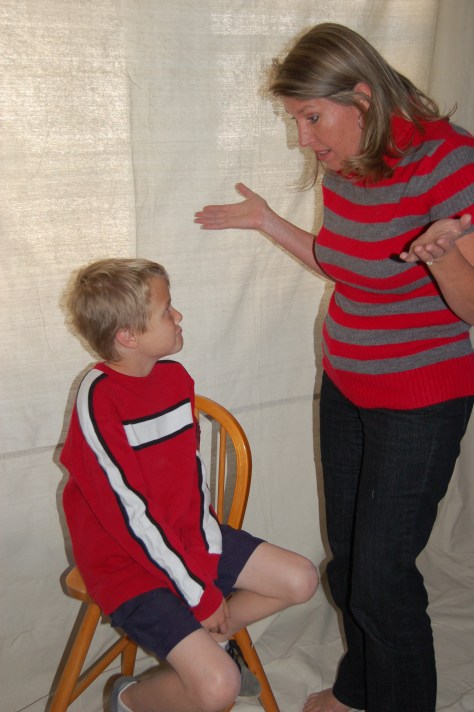
 Don’t scream, threaten or plead. None of these behaviors is effective in shaping behavior. This is a lesson that I have had to learn over and over again, but the clearest lesson came during my pregnancy with baby number four.
With each pregnancy I spent between two and three months in bed with extreme “morning sickness,” but this one was the worse. Even when I felt good enough to get up and around I was still nauseated much of the time. As the nausea slowly subsided I became so large and uncomfortable that I didn’t want to do much. The kids seemed to do okay with Mr. Mom, Dad, pitching in around the house and some friends and relatives took the girls part of the time, but as summer approached and the kids were home all day I realized that there was a problem; I had lost control. My children had become used to a lump in a bed that barely had the strength to speak to them, let alone discipline them. As I slowly became their mother again they did what any healthy child does, they challenged my authority! I didn’t have the strength to get up and enforce my requests, or demands, so I did what most moms would do in the same situation; I screamed. When yelling didn’t work I threatened, and when threatening didn’t work, I yelled louder. The more I yelled, the less they listened. How could they do this to me? I’d been sick, and I was still weak, I was fat and uncomfortable, I didn’t want to move. If they really loved me wouldn’t they feel compassion and help me?
One day I woke up with a scratchy throat and a hoarse voice. As I went about my usual yelling, and screaming my voice quickly disappeared. I had enough trouble getting my kids to listen before. How could I ever get them to obey me with no voice at all? My voice was gone for a week, and that week changed everything. Instead of the mayhem I expected my house was now calm and relaxed. My children were in control, and seemed much happier. What was the secret? The answer was so simple and it had worked in the past, I don’t know why I missed it. The answer was silence. When I stopped yelling so did my children. When I whispered, they listened. “Who was this quiet woman, and what is so important that it must be said in a secret?” they seemed to be thinking. I learned some important lessons during that week. None of them were new or revolutionary, but they do work. I think many of us, in our hurried and hectic lives, lose sight, for a time, of our goal in raising our children. If our goal is to produce well adjusted, productive adults, yelling and threatening never accomplishes the goal. The suggestions below are a step closer to that goal, and some important tools to help you keep your cool. Your children will never really be in control until you are in control. These steps will help you be in control. A parent that is in control will always remember to not get mad, and just get busy!
Psst! Come here!- Children are more responsive to a quiet, interesting request than yelling. It is easier to tune out a loud sound, and the louder you are, the louder they need to be to drown you out!
Get UP!- You can’t be an effective “armchair parent” any more than you can be an armchair quarterback. As hard as it was for me to get up when I was pregnant, in the long run it was easier.
Don’t Threaten– “I’m gonna break your arm if you don’t stop that!” I knew a woman who often threatened “bodily harm” to children in her care. She knew she wouldn’t hurt them, and so did the kids, so why say it? Even seemingly innocent threats can often backfire. If you threaten to not take a child on a family outing if they don’t behave, and then they don’t, what do you do? Keep the whole family home? Try and find a babysitter at the last minute? And if you take the child anyway what does that tell him? You don’t want to leave him home, you just want him to behave. Try a quick, short term consequence, “If you poke your sister again, I will take the pencil away.” Or, better yet, just take it away, and give it back when better behavior is demonstrated.
Count to 3- This can be controversial, but I find counting works. “Come in the house by the count of three,” gives a definite deadline as to when it must be accomplished. “Let’s see if you can put all the blocks away before I count to 10,” gives a sense of urgency. If you find they’re stalling, count faster, and be sure to follow through if your child does not respond appropriately.
Time Out- It doesn’t do much good to count if there’s no reward or punishment at the end. Rewards work best. “We can all have dessert if the toys are picked up by 10,” or an extra ½ hour of TV, or a star on a special chart. And, it’s amazing what kids will do for a stamp on the hand or a sticker! But, there are times when punishment is in order, and a “time out” is the best for young children. Time out can be a very effective tool, but it must be used properly. The key to an effective time out is that it ends the child’s disruptive behavior, excludes the child from the main activity of the family, and that it be quite brief. You should tell the child precisely why he she is taking the time out, but refrain from long explanations. An upset child is in no shape to hear a lecture, and too much time spent with the child can be a reward of more time with you. Remember, your goal is to exclude the child from your attention. Many families designate one spot in the house, such as a special chair or the bottom stair of the stair case, as the time out spot, however this is not necessary. So long as the spot chosen is away from the main activities of the household and does not have other stimulating activities (toys, TV viewing, etc.) it can be effective. A guideline that is sometimes used to determine the time limit for a time out is one minute for every year of age. A three-year old, for instance, needs a 3 min. time out. Time out should be more of a time for a child to calm down and regroup than a typical punishment.
 Discipline does not work in a vacuum. Before you can shape and guide your child’s behavior you must first build a home where the child feels safe and you must establish a good parent-child relationship. There is a basic principle in discipline that states that you cannot effectively discipline a child who does not know you.
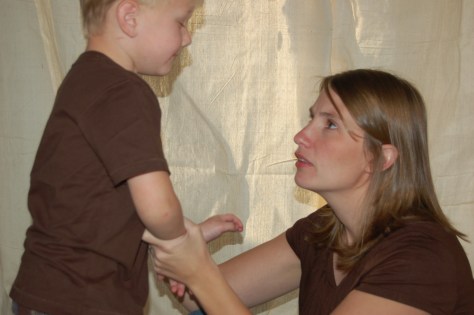 When we think of discipline we usually think of punishment. How many of our parents or grandparents exclusively used a “whipping” as a way to punish their children? Child care experts now advise that physical punishment is not the best mode of discipline, but few of us have really been trained to use effective alternative methods. Although punishment is often used in disciplining children, it is actually a very small part. Good discipline will not just offer rewards and punishments for behavior, it will actually shape behavior.
 Raising kids was going to be a piece of cake. I was the oldest of 4 children and spent most of my older childhood and teen years helping with my siblings and babysitting all of the neighborhood children. My sister and I would watch several families of children at one time and take them on fun outings to the park or the ice cream store. I studied child development in both high school and college and spent 5 years working as a preschool and kindergarten teacher. I was also in charge of the after school childcare program at the school where I worked and was viewed by my co-workers as the best at handling the children that no one else could. Yes, after handling a classroom full of children raising a family would be easy for me. My husband, who loved kids and was the oldest of a large family, and I determined that we would have 12. Well, maybe not 12, but at least as many as we could afford and handle. We would be great parents!
 We are over reacting, we are not taking this seriously enough; when it warms up the virus will diminish, sunshine will not lessen the spread of the virus; stock up on supplies, don’t wipe out the markets; this will blow over in no time, it will take years to recover; this will wreck our economy, we have lots of support in place so we will be fine; our leaders are doing a good job of keeping us safe, our leaders are nuts, just what are they thinking?
  Just my Opinion