
All posts by Karen Dimick

As a mother of five, a grandmother of nineteen, and a teacher for over 40 years I have been interested in writing about topics that relate to children and education for some time. During much of that time I dabbled in writing and did some work as a freelance writer, and then published my first book in 2009, Don’t Get Mad, Get Busy! A Handbook for raising terrific kids!” This blog was born of that endeavor as a way to promote my book and share my thoughts and ideas about topics I felt were important for parents, children and their education. In 2010 I embarked in one of the most challenging teaching experiences I have ever had, short of the full time job of raising my own children; teaching early morning seminary. As a member of the Church of Jesus Christ of Latter-Day Saints (commonly known as the Mormon Church) I am a part of a lay ministry in which we lead and teach one another. Part of our educational program for the youth of our church includes a 4 year seminary program for high school students. Here in OC, CA classes are taught at our local church buildings before school begins, beginning in our area at the unearthly time of 5:45 am. So, for 4 years I spent much of my time studying, preparing, getting up early and catching up on sleep while serving as an early morning seminary teacher. It was a wonderful, difficult, and rewarding experience, but after 4 years I was ready to have a bit of my time back. With my release from that position I had time to resurrect this blog and once again return to writing about topics that I find important to the growth and development of children. My experience and expertise comes not only from my experiences as a parent, teacher and writer. I also hold a degree Early Childhood Education, a BA in Psychology, a Multiple Subject Teaching Credential, an Education Specialist Credential and a Master's Degree in Special Education. I currently work as a Resource Specialist and Special Education teacher working with middle school struggling readers, students who have difficulties in math as well as students with organizational and assignment completion difficulties.

Chapter 4- Start with Praise and Small Rewards

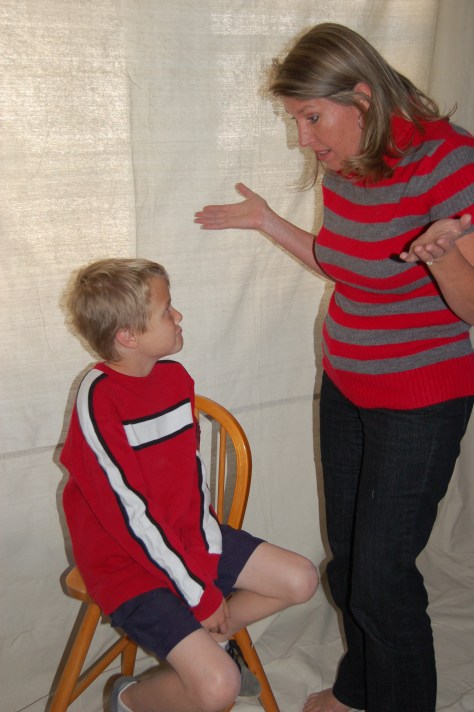
DSC_0041  Young children love praise and rewards.  It never ceases to amaze me how easily you can change a young child’s attitude and behavior with sincere praise or a small reward.  It also never ceases to amaze me how many parents forget this simple fact and get into arguments and power struggles with preschool aged children, myself included.  As I raised my children their behavior seemed to go through phases.  When my children were behaving things were great and I just assumed this behavior would continue, even though I often did nothing to help maintain it.  Then one child would go through a difficult phase and start to question and defy my authority.  This was not the usual behavior for this child, so at first I may just ignore the behavior or use a gentle reminder that this behavior was not okay.  But my son or daughter was not just having a momentary lapse in judgment.  My child was going through a normal developmental stage of testing me and/ or trying to separate from me.  I hadn’t realized this yet, so I continued to ask my child for compliance, and as the asking failed to work the requests often turned into begging or threatening.  As the other children in the family saw me lose control of one child they would often “jump on the bandwagon” and begin to misbehave also.  Meanwhile, I had become so used to my children behaving well that I was totally out of the habit of praising my children for good behavior.  At this point I was also out of the habit of implementing any reward system well or at all, so when the kids misbehaved I would forget to get busy and just get mad.  When I realized that something was really wrong and changed my approach, it would take me a lot of time and effort to get everyone back on the right track.  After a period of time things would be running smoothly again, and I would gradually put less and less effort into praising my children’s good behavior and become more lax with my current reward system.  This was usually followed by a period of time of good behavior, but then the cycle would repeat.

There are several things that can be learned from my family’s cycle.  First, try not to get out of the habit of praising your children.  Look for times to catch your child being good, and complement him about it.  We all love complements, and children are no different.  This is especially true for small children.  You can see a very big change in a small amount of time if you start giving your child authentic complements on a target behavior.  Be careful with praise, however.  Remember that praise does need to be authentic.  Children can spot a phony a mile away, and if you start complementing your child for things that are not truly worthwhile or do not deserve praise she will not take your complements seriously.  Praise should not be given so frequently that it becomes common place.  Complements that are given too frequently can be just as bad as no complements at all as they lose their effectiveness.

The next lesson that can be learned from my family’s behavior cycle is to always look for the reason behind a child misbehaving.  All human behavior is motivated by a “want” or a “need”.  A child may misbehave because he wants a toy, something to eat or your attention or he may have an unmet need.  Parents often have a difficult time determining their child’s unmet need as needs change when children grow and develop.  The sooner you meet a child’s unmet need the sooner you will see improved behavior.  The longer it takes to fill a need the more likely it is that your child will develop behavior patterns that will turn into bad habits, so it behooves parents to find and fill children’s needs as soon as possible.  This is something that it took me many years to figure out as often this concept seemed counter-intuitive.  My basic understanding of behavior modification as a young mother caused me to believe that if a child cried for more attention and I provided it, that my response would act as a reward and cause the child to whine more.  My naïve understanding of behavior modification did not take into account the child’s deep need for more attention.  When I did not respond to my child’s need she needed to try more and more sophisticated ways to try and fill that need.  These ways would then turn into problem behaviors that were often difficult to extinguish.

To determine the reason for a child’s problem behavior you need to really get to know your child and then you need to look for the cause of the behavior by trial and error.  Learn to watch your child at an early age for signs and signals of what she needs.  Contrary to popular belief it is very difficult to spoil a baby.  Recent research has shown that children come to this life with much of their personality predetermined.  If you have a child that demands a lot of attention at a young age, that child needs a lot of attention, so provide it.  If you really get to know your child early on you will understand his moods and needs and you will understand right away when things have changed for him and that he is going through a new stage.  This will give you some clues as to what her new need may be.  However, since children are constantly changing you cannot really be sure until you have tested your theory through trial and error.  If your child is crabby, give her more hugs; if she is demanding, give her more control over her life; if she hits other children; give her some alone time; if she does not share, make sure she has a few toys that are hers alone.  If you fulfill your child’s unmet need his behavior will improve.  As behavior improves be sure to give plenty of praise so you can sustain the improved behavior.  If behavior does not improve then you have not found your child’s unmet need, so keep looking.  Children are very complex creatures so it may not be easy to pinpoint their needs.

Praise can be a good motivator for children, however adults and children alike often need something a little more concrete and systematic to shape behavior.  My family’s behavior cycle clearly shows that when simple shaping of behavior and praise are not effective it is time to enlist a stronger motivator.  There are two ways to provide concrete rewards.  One is to simply provide a reward when you see appropriate behavior.  This works well for very young children, however it is not always practical.  With this method rewards need to be very small and something a child can collect, such as a sticker; or consume, such as food or candy.  Young children love to put stickers on their clothes or hands, and they also enjoy putting together sticker books.  There are special books you can buy with slick pages so stickers can be re-stuck, however just a small, inexpensive notebook can also be used to collect stickers.  Food and candy can also be good motivators, however use these as rewards sparing.  Children that are often rewarded with food and candy may learn inappropriate messages about food.

A second way to provide concrete rewards is through a simple token economy.  In a token economy the child is given a small item when he performs a target behavior.  The item, however, is not the reward.  The items are collected to earn a reward.  The items collected can be a sticker or stamp on a chart, small tokens or carnival tickets.  This method has several advantages over the simple reward system.  First, it is a bit more portable.  When a child is working for a large reward it is easier to promise a ticket when you get home than the actual reward itself.  Second, this method requires less actual rewards to be given, and it makes it possible for children to work for larger items.  Of course you will need to come up with the reward, however this method allows you to reward appropriate behavior with non-tangible items such as a night out with Mom or Dad or an extra half-hour of TV viewing.

If you use a token economy make sure your child is old enough to understand how the system works.  Before the age of 3 or 4 many children cannot understand that they will need to wait for a reward, so a direct reward may be preferable for children under 3.  Make sure that the guidelines are clear to both you and your child as to exactly what behaviors will earn a token, who will decide to award the token, when it will be given, what the reward will be and how many tokens are needed for the reward.  Be sure not to make it too difficult or too easy to earn the reward.  If it is too easy you will have to be constantly providing rewards, and if it is too difficult your child may give up before the reward is earned.  Generally it is best to start with a small reward and a small number of tokens needed to earn the reward, say five or ten.  Once the child understand the system you can gradually increase the size of reward and the number of tokens needed to earn a reward.  Remember, change is constant, so don’t be afraid to change your system if what you are doing does not work or loses its effectiveness.

One important consideration with young children and token economies is where the tokens will be kept.  It is a good idea to have a specific place to put the tokens, especially if you have more than one child in the family that is using the system.  This alleviates the problem of children losing their tokens or of the wrong child claiming them.  Much of where to keep your tokens will be determined by what you use for tokens.  Below is a list of ideas of possible containers that you can use to keep your child’s collection along with tokens that can be used.  Children love cute and unique ideas, however remember that the focus should be to improve behavior.  Do not develop a system so elaborate that the child looses focus on what he should be doing.  Also, don’t overextend yourself.  This should simplify your life not make it more difficult.  Make sure the system you use fits your personality and time schedule.

  • Charts– This can be as simple as a piece of paper stuck on the refrigerator or as complex as a graph or pocket chart mounted on the wall. Pocket charts can be purchased at teacher supply stores or made by folding and attaching paper or fabric to cardboard.  Poster board with graphs drawn on them can also be purchased or they can be made.  The advantage of a graph is that it makes it easy for children to see how their progress is coming toward their goal.  Tokens for simple charts can include stickers, stamps or a happy face or star just drawn on the paper.  For graphs small stickers or stamps can be purchased specifically to fit on the chart.  If you use a pocket chart you can be a bit more imaginative with your tokens.  You can use pictures cut from magazines or figures cut out of construction paper.  You can also purchase pre-made cut-outs.  Calendar cut-outs are available at teacher supply stores and die-cuts can be made or purchased at stores that carry scrapbook supplies.  It is always a good idea to take steps to preserve any paper tokens that you use.  Lamination is the most durable way to preserve your paper creations, however you can also use clear contact paper affixed to both sides for this purpose.
  • Open Containers– An open container, such as a plastic cup or decorated can, can be used to store stick tokens. This type of container can be kept on a counter or table top where the child can easily see and handle their earned tokens.  Young children especially enjoy tokens that they can handle and count over and over.  You can make stick tokens with popsicles sticks, tongue depressors, straws or long strips of construction paper (laminate or cover paper with clear contact paper to prolong life).  You or your child can decorate these tokens with markers or stickers or you can glue cutouts or odds and ends (small stones, pieces of broken jewelry, macaroni, etc.) to the sticks.
  • Closed Containers– Closed containers should seal tight and provide plenty of room to collect enough tokens to earn a reward. Empty food containers with tight fitting lids work well for this as do empty baby wipe containers and zipper bags.  If you have multiple children using this token system be sure to clearly label containers with each child’s name.  Tokens that can be used with this container include carnival tickets, plastic counters or small toys or game pieces, juice lids (from frozen juice cans), milk lids (from gallon milk bottles) or pennies.  The advantage of this system is that the container is small and portable, however this also makes it easier for your child to lose.  Be careful with your choice of small tokens if you have children who put things in their mouths.  Pennies and other small tokens can be choking hazards, and should only be used with children over 3 years.


To give you an idea of how a token reward system can work I will share with you one system that worked with my children when they were young using carnival tickets.  I gave each child an empty margarine container with his or her name on it.  My children loved to count and recount their tickets, so I allowed them to keep the containers in their rooms, however I found that this led to some conflicts over tickets.  To alleviate this problem I began writing the first initial of each child’s name on the back of the ticket.  This way the tickets could not be found, traded or taken; they had to be earned.  I found that it worked best for me to only award tickets one time during the day, so each evening I would award tickets.  During the day I would let the children know when and how many tickets they were earning, however they would only receive them just before bed.  This is not the strongest way to reinforce behavior as behavior is best reinforced immediately, however a behavior system is only as strong as your ability to implement it.  In order to be sure that I remembered to give tickets every night I worked it into our bedtime routine.  As I gave out the tickets I would tell each child exactly why he or she had earned each ticket.  If the children believed that I neglected to give an earned ticket I would always listen to their opinion, however I always retained control over ticket disbursement and did not allow negotiations.  About once a week after tickets were distributed I would allow the children to pick prizes, if they had enough tickets.

Needs changed over time so tickets were given for different actions at different times, but actions such as how children treated their siblings, how chores were completed or how well they obeyed parental requests were considered when distributing tickets.  Just as the reason for tickets being awarded changed, rewards to be earned also changed.  When I first used tickets I had a box of small carnival-type prizes that my children could purchase with their tickets.  At first all prizes were the same number of tickets, but eventually some prizes seemed to be more popular so I varied the value of some.  The kids loved to plot and plan which prizes to save tickets for, however after a while I got tired of picking up all the little toys.  Later, I added edible prizes and prizes such as a date night with Mom and Dad or a trip to the ice cream store.  The ticket system was very effective and I was able to use it for some time with my children with just a few variations.  It allowed me to reward a variety of positive behaviors and gear rewards to each child’s interests.  As my children grew they eventually outgrew this system.  As their rewards became more sophisticated and the number of tickets earned grew from the 10’s to the 100’s it became cumbersome and unwieldy to administer.  At that point I moved to more sophisticated and complex token economies that more closely matched my children’s needs.  For more on token economies see chapter five.

Chapter 3- Now, Follow the Ground Rules for Proper Implementation

DSC_0169From the book, “Don’t Get Mad, Get Busy, A Handbook for Raising Terrific Kids” by Karen E. Dimick

Unwritten Rules

Now that your home is safe and secure, and you are in control of yourself it is time to build some structure into your family organization and take control of your children.  Family structure is built one day at a time, one rule at a time and usually one child at a time.  Most parents do not have a list of rules set down on the day they give birth to their first child.  Most family structure is developed as a need is seen or as problems arise.  Most parents, however, do begin their families with a set of unwritten standards for raising children.  Unfortunately parents do not always question their unwritten standards or why they hold them and they often do not communicate these unwritten rules well to each other.  Research has shown that the number one determiner for how parents raise their children is how they were raised.  This is great if you had a wonderful childhood and your parents did everything right, but since this is rarely the case it is important for parents to question and consider their unwritten rules.  It is also important for parents to discuss their ideas and expectations on child rearing with each other.  One of the most important things that parents can do is to build consistency in their methods and build unity between parents.  Even if you and your spouse both had wonderful upbringings they were likely very different.  Without careful consideration of methods and communication between parents you will likely fall back on what you saw your own parents do and say, and your spouse will do the same.  This usually leads to a mixture of effective and ineffective inconsistent methods.  When children are parented in this manner they sense that parents do not really have a reason for many of the things they do or say and lack control.  Children who do not feel that their parents really control the family will try to bring control to their lives by taking it themselves.  In the long run children who try to take control of the family are unhappy and never content.  Children need consistency and parents who head and pilot the family.  The first ground rule, therefore, is that parents consider and communicate with each other parenting ideals and methods.

Family Resources

The next ground rule is that parents should always retain control of family resources.  In a family there are certain rights that each child has, and there are certain privileges.  Parents should agree on which family resources are rights and which are privileges, and should clearly communicate these to the children.  Parents have a responsibility to provide basic rights to all children in the family, and children should know that these basic rights will always be provided simply because the child is a part of the family.  Rights may include three balanced meals a day, clean clothing to wear and a safe and clean place to play in the day and sleep at night.  Privileges are family resources that can be accessed through appropriate behavior, completion of family responsibilities and completion of outside responsibilities (homework, church and community obligations, etc.)  Privileges may include the child’s favorite meal (including convenience foods, snacks and fast food) or dessert after dinner, designer or specialty clothing, a child’s own room, special or fancy toys, TV viewing time or video game use.  Parents should make it very clear to children the difference between a right and a privilege and should take steps to control children’s use of privileges.

Simple as this principle may sound, parents often have difficulty retaining control of family resources.  This is especially true of media and electronic resources.  One thing that can cause this difficulty is if a TV set, video game system or telephone is kept in a child’s room.  For this reason, as well as others, our family chooses to keep all TVs, computers and video game systems in a room accessible to all family members.  Our older children could have a phone in their room, but they had to show that they could use it responsibly and follow the family rules.  Parents should teach their children to ask permission before accessing these family resources and should take steps to prevent their children from using this equipment without permission.  This can be done through the use of parental controls available on some TVs and computers, through the use of software or web-based blocking services or through removal of hardware such as power cords or game controllers.

Prepare for Change

The next important ground rule is to not get too comfortable with what you are doing.  One of the things you can always count on in child rearing is change.  Children grow and change, you change and circumstances change.  Be prepared to change your methods as your children grow and as circumstances change.  You should also be prepared to make changes just to keep things fresh.  Parents who get too comfortable with methods or procedures and fail to update or change them are bound to experience frustrations and failure.  Change is necessary in child rearing because both parents and children become tired of the same old thing.  Parents who continually use the same methods without some change or modifications will find that they do not implement them with the same effort or follow-through that they exhibited early on.  Change and modification keeps you on your toes and keeps you interested.  The same is true for children.  Children will quickly become bored of the same rewards for the same actions over a long period of time.  If you change it up often, however, children will remain interested and afford their cooperation.

Know your Limits

The next ground rule is to know your own limits.  Some of the techniques and methods explained in the book are very complex and detailed.  Some of my children had quite severe behavior issues and were adept at finding ways around simple behavior modification techniques.  I found it necessary, therefore, to devise some detailed plans and methods.  These detailed methods were only used for short periods of time and only with some children as needed.  All methods are only as successful as your ability to implement them.  If you cannot implement a technique in its entirety then don’t choose that technique, or modify it so it fits your personality and schedule.  I found that the most successful techniques were the ones that I worked into my schedule.  For example, if you choose to give you children points everyday for certain activities you will need to decide what time during the day the points will be given, how the points will be tracked and who will decide how many points are awarded.  If you do not have a time each day to award the points, then look at giving points once a week, with a way to track what is being done on a daily basis.  And be sure to plan a specific day and time each week to track and award points.  The goal should be to make your life simpler, not more complex.  Use the simplest technique that is successful for your child and only increase the complexity to a degree to which you are able to successfully implement it.

Remember your Ultimate Goal

The next ground rule is to take each step in child rearing with the end in mind.  As mentioned before, parents normally parent their own child the way they were raised.  Rarely do we look at our actions and consider the possible consequences.  What happens if I give in to a child who begs for something after I have already said no?  The child learns that begging is a successful tactic to get what she wants.  What am I teaching my child if I put his things away when I told him it was his responsibility to do so?  I teach him that he is not really responsible.  If he doesn’t finish his work someone else will step in and do it.  Take a moment right now and think about what your ultimate goal is.  What do you imagine your child should be doing 10, 15 or 20 years from now?  What are you doing to move your child toward that goal?  My goal, as a parent, has always been to raise happy, healthy, well adjusted adults.  Many times I had to step back and look at my actions to reevaluate if what I was doing was bringing me closer to that goal or further away.  With that long term goal in mind I determined that it was important for my children to learn the following important principles.


How to WorkIf you look at people who are truly successful in life you will realize that they all know how to work. I believe that work is important to all.  It brings satisfaction and gives a feeling of purpose.  The only way to learn to work is by working.  Very young children love to work.  Use that love early on and give your children little jobs.  Often it is easier to do a job yourself than to have a young child do it, but remember to keep the goal in mind.  Are you more concerned about raising a child or keeping a clean house?  As children grow chores should be increased and children should be held responsible for completing them.  Make sure the chores are needed and meaningful, but realistic.  Chores should not be made up or contrived.  They should be tasks that benefit the child himself and the entire family.  I feel it is important that not all chores revolve around the child’s needs.  Children should have responsibility for caring for their own belongings, to the extent of their age and maturity, but they should also have some responsibilities that benefit the entire family.  This helps them feel important to the family and teaches responsibility.

Remember when assigning jobs and chores to keep in mind the skills and age of the child and their time constraints.  You also need to keep in mind how much time you have to teach the skills necessary and always remember what your ultimate goal is.  I once met a mother who told her children that their only job was to be good students.  She would do everything around the house, including cleaning their rooms and picking up after them.  I carefully considered this point of view and wondered if my husband and I were not putting enough of an emphasis on my children’s school work.  After thinking of the long term consequences for this attitude I realized that this was not what I wanted to teach my children.  Of course it was important for my children to learn in school, but being a good student did not hold nearly the importance for our family of learning responsibility and learning to work.  Rarely in a job interview does a boss ask what your GPA was, however if you do not know how to work hard and carry out responsibilities you will not be a valued employee.  Children who have no other responsibilities other than school work learn that they are entitled to have people wait on them and take care of them while they complete their studies.  This is not a realistic view of the world and it does not teach children skills that are necessary and important in life.  For more on jobs and chores see chapter seven.


Education as a Lifelong PursuitAnything in this life that is worthwhile can be had through hard work and proper education.  Often we think of education as the years that we formally attend school, however your child’s education begins the minute he is born, and continues throughout life.  The school system will assume a lot of responsibility for educating your child in certain areas, however you as the parent are ultimately responsible for her education.  Education is much more than learning to read and write or about science or history.  Education includes book learning that children receive in schools as well as communication and social skills; physical fitness and nutrition facts; sports skills and etiquette; citizenship and community awareness; values and ethics; and facts about music and the media.  Public schools touch on many of these areas, however depth in these areas is taught in the home.  Parents should decide when their children are young what they feel is important for their child to learn in this life and then emphasize leaning on those areas.  Many parents today teach their children that sports participation is the most important thing.  This may not be their intention, however so much time energy and emphasis is placed on this area of the child’s life that he learns this lesson inadvertently.  If you feel that sports involvement is ultimately important then this is appropriate, however do examine what you really want to teach your child before you spend large amounts of time in this endeavor.

Make sure that children understand that learning is a lifelong endeavor by continuing your education.  If your child sees you reading, taking classes or gaining skills to enhance your career she is likely to take the pursuit of education seriously and continue that pursuit throughout her life.

One thing that parents must realize is that learning cannot be forced or pushed.  Young children have a natural desire to learn.  As children age they go through developmental stages that are optimum for learning different skills.  Take advantage of this early zeal for learning and of various developmental stages and give your child the tools to learn when the time is right.  If you develop a habit of learning and growth when your child is young this will help through the difficult stages when your child is less than enthusiastic about education.

Parents should teach their children that their school performance is very important; however they should also balance the amount of emphasis they place on grades versus what the child is really learning.  Some children learn early on how to perform well in school, and others do not have this skill.  Grades are a good indicator of how well children perform the tasks assigned by the teacher, however they do not always reflect what the child is learning.  Although it is always appropriate to applaud excellent behavior and reprimand less than adequate behavior be careful about giving large rewards and punishments for grades.  Research has shown that children and adults alike benefit most from intrinsic rewards, or the reward of inner satisfaction.  Children who are continually rewarded for activities that give them internal satisfaction begin to lose that internal satisfaction and look for the reward itself.  Conversely, punishment rarely helps a child perform well in school.  Most children want to do well in school, and when a child is not performing well it is usually a sign of a missing skill, a lack a motivation or a disability.  Poor grades should have consequences, however the consequences should include teaching the necessary skills or learning to cope with the disability.  For more on this topic see chapter eight on school performance.


Communication SkillsA person who knows how to communicate effectively and positively will get much further in life than one who does not.  Your child will first learn how to communicate by listening to you.  How do you talk to your child and others around you?  Are you polite and patient when communicating a need, or are you rude and impatient?  Do you use language that you would like to hear your child repeat?  Not only does your child learn from listening to you, he will also learn from direct instruction and practice.  Encourage your child from the time that she starts to speak to “use her words” to communicate instead of yelling, hitting or grabbing things.  When your child has an altercation with a friend or sibling take some time to help him practice communicating his needs, wants and feelings.  Children should be taught to communicate their feelings about a situation.  When most of us are upset we tend to point fingers and make accusations on what the “other person” did to avert responsibility.  Children are no different.  From a very young age they learn to blame their “upsets” on others.  No matter the age, when finger pointing begins and accusations are made communications break down.  Instead, teach children to start by stating their feelings, and then their needs.  “I feel upset and I need my toy back,” clearly communicates what is wanted and keeps the lines of communications open better than, “You took my toy, give it back!”  Psychologists call these “I” statements, and I statements open up communication instead of inciting arguments.  For more on this topic see chapter 9, Family Communication.


Compassion in the Home

The last ground rule is to remember compassion.  Children do need rules and order, however rules should not take precedence over expressions of love and understanding.  I was once taught by an English teacher that there is an exception for every rule, and that is true for every rule in the house.  Exceptions can be made because of an unforeseen event, because a child makes a good argument for an exception or because you realize it may not be in your family’s best interest to enforce or continue with the rule.  If bed time is 8:00 and Aunt Sarah shows up for a visit at 7:45, don’t immediately hustle the kids off to bed because it is the rule.  Carefully consider the consequences, and then think about making an exception this once to go to bed a bit late.  If the rule is that no one is allowed to have dessert on a weeknight and your son points out that the local ice cream store is having a special sale, consider his argument and if the consequences are not too dire consider an exception.  Be careful, however that the exception does not become the rule, and be sure to explain the reason for the exception.  If the exception is more common that the rule, then there is no point in the rule.  Children quickly learn that you can be manipulated easily if you are constantly making an exception.  Exceptions should never be made, however, if children begin begging and whining.  Listen to your children when they make a good argument to change or suspend a rule, but once begging or whining begins put your foot down and do not give in.  Teach your children to communicate by using a good argument, not by whining and nagging.

You should also remember compassion when you discipline your children.  Remember that the goal is to shape your child’s behavior, not to be punitive or seek revenge.  Instead of thinking of punishing your child think about providing consequences.  All actions in life have consequences, some good, some not so good and some neutral.  Some actions your child takes will have natural consequences that will adequately teach her and guide future actions.  If your daughter leaves her lunch at home, the natural consequence will be that she will go hungry that day.  Natural consequences teach children the quickest and are the easiest consequence to provide, however they are not always feasible or desirable.  If your daughter left her lunch at home because she hates what you packed for her and her friend brings a better lunch that is big enough for two the consequence would not teach the lesson you want her to learn.  If your son begins to run into the street in front of a big truck the natural consequence of his actions would be too dire to allow.  If possible, allow natural consequences to teach your child, but be mindful of possible unintended lessons or dire consequences.  If natural consequences are not feasible you can provide logical consequences.  Logical consequences do not happen naturally because of an action, however they are closely linked to the action in some way.  As an example, if your child does not get up for school on time, a natural consequence could be an earlier bed time the next night.  Logical consequences require an adult to impose and administer.  They are not as powerful a consequence as a natural consequence, however they are much better than totally unrelated or arbitrary consequences.  Sometimes it is difficult to think of a logical consequence for a behavior, however it is well worth the effort.

Don’t feel like you have to come up with a consequence immediately after your child misbehaves.  Feel free to tell your child that there will be a consequence for his actions, but that you will discuss it later.  Take your time to carefully consider a consequence that will adequately teach your child and shape his behavior.  You can also ask your child what he thinks is an appropriate consequence.  Often you will find that your child is stricter than you would have been.  Be sure to explain the consequence with your child and how it relates to his behavior.  Explain that the consequence is designed to help him and teach him to not make the same mistake again.  If your child disagrees with the assigned consequence listen to her argument and take her point of view into account.  Remember, do not allow whining or begging, but a conversation with a differing point of view should be encouraged.  Once your child presents her point of view consider it carefully, then give your decision and don’t back down.  If you disagree with your child explain why, and if you agree explain that also.  Don’t be afraid to change your mind and give your child a different consequence than originally promised, especially if you made a decision quickly or in anger.  If you do change your mind explain your reasoning carefully and explain why the new consequence is more appropriate.  If you acted too quickly or in anger tell your child that you acted rashly and apologize.  Your child will respect you more if you are willing to admit your faults and try to rectify them, than if you try to cover them up.  So don’t get mad, get busy, and if you forget and do get mad, go back and try again.

Chapter 2- Next, Get Yourself in Control- The Silent Week

DSC_0161Don’t scream, threaten or plead.  None of these behaviors is effective in shaping behavior.  This is a lesson that I have had to learn over and over again, but the clearest lesson came during my pregnancy with baby number four.

With each pregnancy I spent between two and three months in bed with extreme “morning sickness,” but this one was the worse.  Even when I felt good enough to get up and around I was still nauseated much of the time.  As the nausea slowly subsided I became so large and uncomfortable that I didn’t want to do much.  The kids seemed to do okay with Mr. Mom, Dad, pitching in around the house and some friends and relatives took the girls part of the time, but as summer approached and the kids were home all day I realized that there was a problem; I had lost control.  My children had become used to a lump in a bed that barely had the strength to speak to them, let alone discipline them.  As I slowly became their mother again they did what any healthy child does, they challenged my authority!  I didn’t have the strength to get up and enforce my requests, or demands, so I did what most moms would do in the same situation; I screamed.  When yelling didn’t work I threatened, and when threatening didn’t work, I yelled louder.  The more I yelled, the less they listened.  How could they do this to me?  I’d been sick, and I was still weak, I was fat and uncomfortable, I didn’t want to move.  If they really loved me wouldn’t they feel compassion and help me?

One day I woke up with a scratchy throat and a hoarse voice.  As I went about my usual yelling, and screaming my voice quickly disappeared.  I had enough trouble getting my kids to listen before.  How could I ever get them to obey me with no voice at all?  My voice was gone for a week, and that week changed everything.  Instead of the mayhem I expected my house was now calm and relaxed.  My children were in control, and seemed much happier.  What was the secret?  The answer was so simple and it had worked in the past, I don’t know why I missed it.  The answer was silence.  When I stopped yelling so did my children.  When I whispered, they listened.  “Who was this quiet woman, and what is so important that it must be said in a secret?” they seemed to be thinking.  I learned some important lessons during that week.  None of them were new or revolutionary, but they do work.  I think many of us, in our hurried and hectic lives, lose sight, for a time, of our goal in raising our children.  If our goal is to produce well adjusted, productive adults, yelling and threatening never accomplishes the goal.  The suggestions below are a step closer to that goal, and some important tools to help you keep your cool.  Your children will never really be in control until you are in control.  These steps will help you be in control.  A parent that is in control will always remember to not get mad, and just get busy!


Psst!  Come here!- Children are more responsive to a quiet, interesting request than yelling.  It is easier to tune out a loud sound, and the louder you are, the louder they need to be to drown you out!


Get UP!- You can’t be an effective “armchair parent” any more than you can be an armchair quarterback.  As hard as it was for me to get up when I was pregnant, in the long run it was easier.


Don’t Threaten “I’m gonna break your arm if you don’t stop that!” I knew a woman who often threatened “bodily harm” to children in her care.  She knew she wouldn’t hurt them, and so did the kids, so why say it?  Even seemingly innocent threats can often backfire.  If you threaten to not take a child on a family outing if they don’t behave, and then they don’t, what do you do?  Keep the whole family home?  Try and find a babysitter at the last minute?  And if you take the child anyway what does that tell him?  You don’t want to leave him home, you just want him to behave.  Try a quick, short term consequence, “If you poke your sister again, I will take the pencil away.”  Or, better yet, just take it away, and give it back when better behavior is demonstrated.


Count to 3- This can be controversial, but I find counting works.  “Come in the house by the count of three,” gives a definite deadline as to when it must be accomplished.  “Let’s see if you can put all the blocks away before I count to 10,” gives a sense of urgency.  If you find they’re stalling, count faster, and be sure to follow through if your child does not respond appropriately.


Time Out- It doesn’t do much good to count if there’s no reward or punishment at the end.  Rewards work best.  “We can all have dessert if the toys are picked up by 10,” or an extra ½ hour of TV, or a star on a special chart.  And, it’s amazing what kids will do for a stamp on the hand or a sticker!  But, there are times when punishment is in order, and a “time out” is the best for young children.  Time out can be a very effective tool, but it must be used properly.  The key to an effective time out is that it ends the child’s disruptive behavior, excludes the child from the main activity of the family, and that it be quite brief.  You should tell the child precisely why he she is taking the time out, but refrain from long explanations.  An upset child is in no shape to hear a lecture, and too much time spent with the child can be a reward of more time with you.  Remember, your goal is to exclude the child from your attention.  Many families designate one spot in the house, such as a special chair or the bottom stair of the stair case, as the time out spot, however this is not necessary.  So long as the spot chosen is away from the main activities of the household and does not have other stimulating activities (toys, TV viewing, etc.) it can be effective.  A guideline that is sometimes used to determine the time limit for a time out is one minute for every year of age.  A three-year old, for instance, needs a 3 min. time out. Time out should be more of a time for a child to calm down and regroup than a typical punishment.

Chapter 1- First, Build a Home

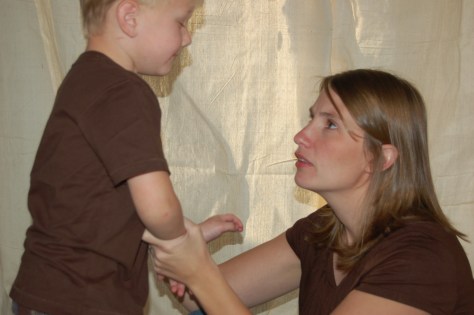
DSC_0248Discipline does not work in a vacuum.  Before you can shape and guide your child’s behavior you must first build a home where the child feels safe and you must establish a good parent-child relationship.  There is a basic principle in discipline that states that you cannot effectively discipline a child who does not know you.
As a teacher I spend time each day for the first few weeks of school getting to know and building a relationship with my students.  I teach them my goals for them and my expectations for their behavior.  I also give them a glimpse of my personal life and personality.  By the end of the school year the majority of my students, even ones with severe behavior problems in other classes, genuinely want to behave in my class and please me.  They may not always behave appropriately, but when I need to reprimand them or correct their behavior they understand the consequence and learn from the encounter.

The same cannot be said for the average student I meet on campus who does not know me.  Even if I use the same techniques with a student that I see crossing campus and not obeying the rules, my actions are usually much less effective and short lived.  The same problem occurs when I have a substitute in my class.  The class who is normally polite and productive for me is often rude and non-productive for my sub.  Discipline cannot truly be effective unless there is a long established relationship between the child and the disciplinarian; hence it is essential that you build a good relationship with your child in order to effectively discipline him or her.

Start when your child is young to build a relationship by reading to her, playing games with him and going on family outings together.  Have conversations about what is going on in your life, and encourage your child to tell you about his or her day.  One of the best places to build positive relationships is at the family dinner table.  Don’t let outside activities or the TV set infringe on this valuable time.  Plan your week so the entire family sits down together at least a few times each week and lingers over dinner.  For every negative exchange that you have with your child you should have many more positive exchanges.  These exchanges should be fun and genuine, not stiff, contrived or scheduled.  Be yourself, and don’t be afraid to let your kids really get to know you.

One of the most important principles in building a home is to be sure that your child feels loved.  “But of course I love my child!” you may say.  But does your child know that he is loved?  Even the parent who neglects or abuses their child may loves him, so what you feel is not relevant.  What is relevant is how your child feels.  A child who does not feel loved will not feel safe and secure at home.  But if your feelings and thoughts are not relevant, then how can you know how your child feels?  You can never really be sure of how your child feels, but the following important steps will show your child that you love him or her and build the kind of relationship that will show love and build security.


Give Hugs and Kisses- Most parents hug and kiss their little children.  But as children grow and become less cute and huggable parents become less affectionate.  As a normal part of growing and separating from parents children in turn are also less affectionate.  They may also rebuff parents who try to show their love.  Paradoxically, at about this same point in time children may need more affection, yet they are getting less.  As children begin to grapple with peer pressure, increased stress in school, building more mature relationships outside of the family, and physical changes inherent with growing up, their self-image and security are challenged.  If your child balks at your attempts to show affection, don’t give up.  Be creative and more subtle, but do show affection.  Give your child a peck on the check or top of the head as he passes by, as she sits watching TV or is playing on the computer.  Don’t be afraid to add an, “I love you,” and do be careful around friends.  The goal should be to convey love to your child, not to grandstand in front of the friends or to embarrass.


Plan Fun Together- As children get older and start to develop outside interests and participate in more activities with their friends, parents often have less time to spend with their children just having fun.  Sometimes with older children and teenagers it seems that all of your time with them is spent in giving instruction and reprimands.  It is therefore important to plan time to have fun together, and it becomes even more important as children grow.  Eat dinners as a family at least a few nights a week and make a rule that conversations are to be kept to light topics.  Plan one evening a week for a family activity.  Plan dates with your kids one-on-one and let him or her pick the place to go.  Use this time to let your child talk, and ask open-ended questions to get the conversation going.  Listen more than you talk.  Take family vacations, even if the trip is just a campout in the backyard with no phones or video games allowed.


Communicate When your children are tiny it is hard to imagine that you will ever not feel close to them.  But somehow, between babyhood and the teen years, communication is often hampered and that little girl who told you every thought and feeling that she had refuses to speak.  Planning family fun can go a long way to help keep the lines of communication open.  Often a child who will not speak to you at home or under a stressful situation will open up and be himself at his favorite restaurant.  Be sure that you continue to communicate openly with your child, even if he or she shuts down.  Talk about your goals and aspirations and everyday happenings.  Just as you plan a time to have fun, plan a time to talk.  Talk over dinner, or plan a time just for communication.  Some families have regular parent child interviews.  The main goal of the interview should be for your child to share and look at goals.  Try writing down important things during the interview such as a list of your child’s friends, teachers names, interests, dreams and future goals.  You can write important facts about your child in a journal or notebook kept specifically for this purpose.  You can use some of the interview time to share ideas or concerns with your child, but this should not be the focus.  Be sure that your child is able to fully communicate their thoughts and feelings, and give your child time to air grievances or complaints about you.  Listen openly, not defensibly, and talk about possible solutions to problems.


Show increased love after discipline- No matter the age of the child it is sometimes hard for them to separate the discipline from the person administering the consequence.  It is important that children realize that parents discipline because they love their children, not because of a lack of love.  After you discipline a child always show an increase of love.  Not only do they need the extra attention to shape their proper behavior, they also need to know that you are not the enemy.

What is discipline?

DSC_0039When we think of discipline we usually think of punishment.  How many of our parents or grandparents exclusively used a “whipping” as a way to punish their children?  Child care experts now advise that physical punishment is not the best mode of discipline, but few of us have really been trained to use effective alternative methods.  Although punishment is often used in disciplining children, it is actually a very small part.  Good discipline will not just offer rewards and punishments for behavior, it will actually shape behavior.
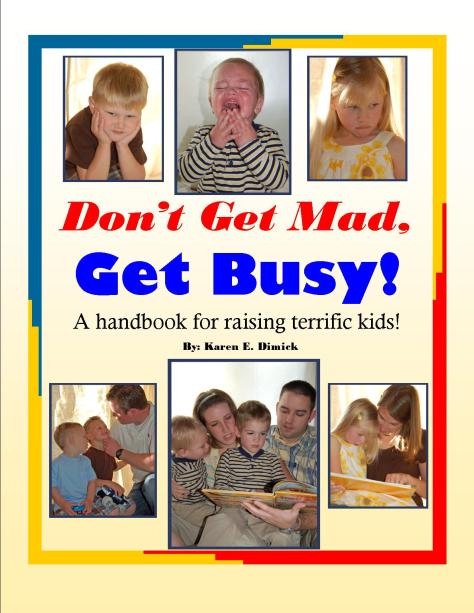
There are many books available that talk about discipline and behavior modification techniques.  This book is not meant to replace any of those books, methods or theories.  This book is meant to be a companion piece to whatever method you choose to adopt.  I found as I read books and articles on parenting and discipline methods they advised over and over to set down ground rules, be firm and consistent, yet loving.  But with each book and article I was left with developing the actual, “how to” implement them with my family.  There were a lot of wonderful ideas out there, but none of them that I could just pull off the shelf and use.  I also found that there were charts and guides that had been developed and offered for sale, but none of them quite fit my needs.  This book, and the forms available to readers at the website www.dontgetmadgetbusy.com, put at your disposal a large array of useful, tested practices that are easily adapted to your family and their needs.

Please note that I have done several things in the wording of this book simply to make my job as author easier.  First of all, you will notice that I have used gender words interchangeably.  I may use him one time, her the next and his or hers the time after that.  This is simply to ease the flow of the book and to add variety.  I am well aware that children and parents come in two genders, so please be aware that these methods will work for both genders, regardless of the wording in each particular part.

Next, I have written this book as if each child were being parented by a traditional two parent married couple.  Once again, this has been done only for ease of writing.  I am well aware that many children grow up quite successfully in a variety of different family configurations.  If your family is not headed by a traditional two parent married couple, please be aware that these methods will be just as effective.  Some of the recommendations may need to be adjusted to fit your particular situation; however all should be applicable for all who want to parent a child.

Raising kids is a lot of work!

Book cover FinalRaising kids was going to be a piece of cake.  I was the oldest of 4 children and spent most of my older childhood and teen years helping with my siblings and babysitting all of the neighborhood children.  My sister and I would watch several families of children at one time and take them on fun outings to the park or the ice cream store.  I studied child development in both high school and college and spent 5 years working as a preschool and kindergarten teacher.  I was also in charge of the after school childcare program at the school where I worked and was viewed by my co-workers as the best at handling the children that no one else could.  Yes, after handling a classroom full of children raising a family would be easy for me.  My husband, who loved kids and was the oldest of a large family, and I determined that we would have 12.  Well, maybe not 12, but at least as many as we could afford and handle.  We would be great parents!

Then my oldest son was born.  He was anything but your typical child.  From the day he was born Baby #1 seemed unhappy with being a baby and wanted to go out and see the world.  He was alert and bright and did everything early.  He rolled over at 3 weeks old, stood in his crib at 5 months and began walking at 6 months, skipping crawling altogether.  By two he had taught himself all of the letters in the alphabet and the sounds they make by watching Sesame Street and by 4 he taught himself to read.  Of course this bright mind and eager body was quite a trial for parents, even parents that were well prepared.  He had endless energy, was always getting into something and seemed to never sleep.  It is a real problem when your child needs less sleep than you do, especially when the child is so busy and energetic that you dare not leave him unattended.  Bedtime was a big problem.  On the average it took our son two hours past when we put him to bed for him to go to sleep.  And this was not a quiet two hours of patiently waiting for sleep to come, this was two hours of getting out of bed, getting into things, running through the house followed by pleadings and threats by my husband and myself for him to stay in bed.

When Baby #1 was two we welcomed Baby #2, a sweet daughter, into our home. Right on her heels Baby #3 came along, when #2 was just 15 months old.  Baby #2 was so different from older brother as a little baby.  She was petite and she actually slept at night and took naps.  She was content to sit in the playpen for part of the day, unlike older brother who wanted to be held constantly.  Not to be outdone by her big brother #2 soon showed that she was not going to be any less of a handful.  She was very busy and had a mind of her own at a very early age.  She seemed to hit the terrible twos at 15 months, just as her sister was born, and she continued to assert her independence and argue with me throughout her life.

After #3’s birth I had to admit I had no idea what parenthood would be like before I actually experienced it.  I thought I could handle it all, but I had no idea what a difference it was to be responsible for your children 24 hours a day, rather than just a few hours.  I couldn’t send these children home to their parents when I had had it; my husband and I were it.  On top of that I had to take care of all the tasks of running a home.  As a teacher I had been responsible for teaching the children.  Here at home I had to cook, clean and do laundry.  In addition to all of that, I had to help my husband support the family financially.  I felt it important to give my children as much of me as possible so I managed to find jobs I could do at home for most of my children’s young years.  With all of the demands on my time the strategies that I had used as a teacher did not apply here because my children were not my only responsibility.

So here I was with a very busy three year old who wanted my attention, a 15 month old who wanted nothing to do with me but wanted to go out and take on the world on her own and a newborn with colic.  Add to that mix three children that I watched to keep my family finances afloat and you can see that to say my life was hectic was an understatement.  I did what anyone would do in a similar situation, I lost my mind.

I knew I was at the breaking point one day when older brother and little sister wanted to play hide-and-go-seek.  The baby was asleep, and I had no extra children at my home, so I decided to take my turn to hide, and I hid in the closet behind the clothes.  It was a really good hiding place and they couldn’t find me.  After sitting there for a while I found I loved the cool, quiet solitude of being in the closet behind those clothes.  I knew the kids were okay because I could hear them looking for me, but they weren’t demanding anything of me.  I was congratulating myself on finding a way to get some peace when they started to cry.  “Where’s Mommy?” they sobbed.  It was then that I realized that parenthood was so much more than enduring our children’s lives, or controlling their behavior.  Parenthood is about loving and nurturing our children into adults.  Sure, this was a whole lot different and more demanding than teaching, but it was also so much more rewarding.  I wasn’t going to get a new class next year, my husband and I were responsible for these children into adulthood, and we would be their parents forever.  I needed to find a way to shape and mold these strong personalities into responsible adults.

When children don’t behave our first reaction is to get mad.  But getting mad doesn’t help.  Years ago parents knew how to handle their children.  The prevailing wisdom was that if you spare the rod you would spoil the child.  So when many of today’s grandparents were children they felt the swift and firm consequence of their behavior with physical punishment.  Most experts now agree that strong physical punishment is neither advisable nor effective.  The problem is that today’s parents have not been given tools that are as swift, firm, speedy and as easy to execute, as a whipping was.  We have been told to use time out or to ground our children, but many parents have found time-out to be less than effective and have found that when they ground their child they ground themselves as well.

After that day in the closet I set out to come up with concrete systems that I could use to shape my children’s behavior with love, but firmness.  I used my experience as a teacher and knowledge of child development and human behavior, as well as trial and error, to develop positive and negative reward systems and record keeping charts to help and guide me.  Many of the systems I developed were developed with the needs of a specific child in mind, but I found that they often worked for everyone.

Nearly 20 years have passed since that day in the closet, and a lot has taken place.  Baby #1 grew into a wonderful boy and young man, and is now a father himself, with an outstanding mind, but with many obstacles to overcome.  He was diagnosed as having Attention Deficit Disorder, dysgraphia (a writing handicap) and a visual processing disorder, which brought many years of struggle through school.  One daughter was diagnosed with Attention Deficit Hyperactivity Disorder, Oppositional Defiant Disorder (which I describe as acting like a teenage for life, and yes, it is a real disorder) and being at risk for depression.  As she grew she was a master at making trouble with her best friend and sister and really had trouble being successful in school.  But now she is a beautiful college graduate with many talents and a knack for doing anything she puts her mind to.  Baby #3’s colic lasted for 6 months, even though all the baby books claimed it only lasted for 4, but when she quit crying we found that she was a happy, delightful, bright little girl.  She is, however, extremely demanding and driven.  She is the princess and I often thought she would have made a good only child, but somehow she was placed in the middle of 5 kids.  She seemed to resent all the extra time I had to spend helping her older siblings get through school and raising her little brother and sister, but she continues to be bright and bubbly and is an outstanding, driven and successful teacher and college student.

After 3 kids in 3 ½ years we took a four year break before bringing #4 and #5 into the world.  They proved to be surprisingly “normal”, although they, as do all children, have had their trials.  I found that many of the strategies that I had developed for my difficult children worked very well with them.  I also have had an opportunity to further use and refine many of the techniques in my job as a middle school teacher.  As I raised my children I had several opportunities to continue my work as a preschool teacher both through a home child care program and employed at various schools that allowed me to bring one or more of my children with me.  When my youngest went to school full time I was able to continue my education and seek employment in public education.  I now work as a Resource Specialist and work with middle school-aged children with disabilities of all types and severities.  Many of the techniques and charts I developed for my own children I have been able to adapt for use in the classroom and I have shared with parents.  These techniques have proven to be useful to help children with various disabilities control their behavior both in the classroom and in their homes.

Some people say my husband and I are nuts to have 5 children.  We may be because it is the hardest thing I have ever done, but raising them has brought me more joy and satisfaction than anything else.  Whether you have one child or ten it is a lot of work to raise children.  Kids may do things that will make you feel extremely mad, but getting mad will not shape and guide your children correctly.  Good hard work, a plan on how to proceed and some good tools will.  So look through the suggestions and guidelines in this book then try out some of the tools and choose the ones that will work for you.  Then, don’t get mad, get busy!

When Tragedy Strikes- Are we handling this right?

DSC_0269We are over reacting, we are not taking this seriously enough; when it warms up the virus will diminish, sunshine will not lessen the spread of the virus; stock up on supplies, don’t wipe out the markets; this will blow over in no time, it will take years to recover; this will wreck our economy, we have lots of support in place so we will be fine; our leaders are doing a good job of keeping us safe, our leaders are nuts, just what are they thinking? 

Likely you have heard all of this, and more, over the last few days. Truly, we are all in awe over the events of the last week or so. Last week, as I was finishing up some missing work with one of my 6th graders in my classroom on the last day of the trimester, and the last day of school until who knows, he and I talked. He had some questions about the virus, school and what was going to happen. I had to tell him I just didn’t know. He was shocked to find out that we haven’t had a pandemic of this caliber in modern times. This is new territory; none of us really know how to act, what to do or what is needed. Truly, our leaders, our communities, our churches, our work places and yes, even our doctors, don’t really know for sure what is the best course of action.  In truth, we may have some ideas and educated guesses, but really, we are all just making it up as we go along.

Wow, Mrs. Dimick,” said the 6th grader when I explained we don’t really know what we are doing, “this is really serious.” Yeah buddy, it is. In a world with so much information at our literal fingertips, it is pretty unusual these days to have a world-wide event that truly we don’t know exactly what will happen or how to handle it. We are so used to having experts and leaders with the answers and advice that really, we are all feeling just a bit anxious.

Some day in the not too distant future the hope is that we will look back on this event and say, “Remember when?” And we will be able to add, “That was a bit crazy, but we got through it, and we did learn something.” But, what will be learn? What are we learning? What are the lessons that will help us better navigate our world going forward? Well, no one knows for sure, but just from what I have seen so far, here my top 9 lessons.

9- Don’t put it off!  Whether it has to do with stocking up with emergency supplies, attending your house of worship or visiting that friend that you can’t get to now, I think we can all say there is probably something you meant to do before, that you can’t do now.  So when the store restocks and we can freely recirculate once again, grab a few more cans just in case, buy a few extra rolls to have on hand, and put a few more things in the freezer because you never know.

8- Appreciate Technology- Yeah, there is the bad side, but can you imagine all of this without it? I am just amazed how many different emails I got with offers of free things to do, or watch or, experience. All I can say is wow, just wow.

7- It’s Okay to Push the Pause Button on Life- Okay, face it people, we live fast paced, crazy lives. Can you not say that having a slower pace for a bit was not refreshing? Was it such a terrible thing to just have your calendar cleared for once? Would it be so bad to really just make that choice for yourself or your family once in a while?

6- Reach Out to Others- With time to slow down I keep thinking about reaching out to others, visiting others, taking them things. Well, that kind of defeats the purpose of where we are right now, so I had to rethink that plan. But it did get me thinking. We need each other, we need human contact. Do we really take the time to reach out when we can, or do we put if off until it is too late (see #9 above). I know I can do better.

5- Grow a Garden– My granddaughter and I have been working on a garden.  She was ecstatic when she found out food may be scarce because we could eat her vegetables! She was a bit disappointed when she found out that it will be many weeks until we have a harvest, but what a great way to be in the out of doors, spend time with your family and produce food that may come in handy when the next disaster comes along.

4- Learn to Cook– So, it is looking like if everyone has enough food in their house to eat at home for a couple of weeks the stores are empty. I was raised in an era where eating in was normal, eating out was for special occasions. When my kids were young I once had a woman ask me if I cook. I felt like answering, as opposed to, what, starving? I didn’t really get the question, I didn’t know there were people who didn’t, with the expectation of maybe the most rich and famous. Now, with just me and my husband home we eat out a lot, but I do keep a stock of food, and I have the capability to cook meals. This is a life skill people, figure it out, and teach your kids.

3- Some Necessities are not Really Necessary- Here is a news flash, life existed before bottled water, before baby wipes, disinfecting wipes and hand sanitizer and yes, even before toilet paper. Guess what people, we still have running water, electricity and natural gas available in our homes so we are actually way better off than those who had to live without those items.  Sure, it may be way easier and cleaner to wipe with something we can just toss, but I bet you have plenty of things right in your own home that you could substitute, if you had to.

2- You Are Ultimately Responsible for your Family- It is easy to think the government will take care of us, that the school will teach our kids or that someone will bail us out. But, when it comes right down to it, it is your responsibility. As a middle school teacher I am daily responsible for upwards of 100 kids a day. I take my charge seriously, and I think I do a good job. But guess what, when we had an emergency where did we send those kids? They went right back to their parents. When it is time to get back to basics in life, you are in charge, you have the responsibility to do what it takes to make sure your family is fed, clothed, educated and taught. Treat it like that.

1- Go forward with Faith, not Fear- This may seem religious, but it is actually biological as well. You see, fear does interesting things to us biologically.  There is a fight or flight response that we often have little or no control over when perceived danger is in play. Having faith and hope that things will work out, that you can handle this, that you can do what it takes keeps the involuntary responses turned off, and the brain turned on.  Stay in the game people, we can do this.


To read more or subscribe, click here.

To read what I have to say with more of a religious slant, check out my other site goatsasndsheep.net.

For my author FB page click here.

And to see what books I have on Amazon, click here.

Our Gun Fixation will NOT Fix the Problem!

weapon-violence-children-child-52984.jpeg

Seventeen killed in a school shooting, it seems as if this last mass school shooting just pushed everyone over the edge.  “Enough!” everyone is saying, “We have to do something!”  Yet, while many agree with this sentiment, the “what” is a very disagreeable topic.  It seems as if the two top “whats” are more gun control or arming personnel to protect students on campus.  And, it seems as if the state of Florida decided to just go for broke and pass laws for both options.  Well, I am probably going to make both sides mad with my opinion, but I think you are both just plain wrong.  I just don’t think the solution as easy as passing more laws.  While I certainly see the appeal for both of these ideas, I don’t think either addresses the cause of the problem.  I will explain, but first an analogy.

I have always been intrigued by magic.  As a kid I collected magic tricks, and spent hours trying to perfect my skills.  I was never very good at it, but there were some tricks that I could successfully perform.  The real secret, I learned, to getting buy in from your audience was the distraction.  All magic tricks involve some kind of bait and switch.  The bait is the distraction, and once the audience is fixated on the bait, you can perform the switch.  I think some issues in our society have become this way.  In our quest for a simple solution we become so bogged down with the idea of that one thing that will fix the problem that we completely miss what the real problem is.  In my opinion, we are so fixated on the bait, the guns, that we have completely missed the switch, the complex issues that led to societal violence.

The issue of increased violence in our society is so much more complex, so much more messy than some of these solutions suggest and can’t be solved by a simple law or initiative.  Not that there are not solutions, but we need to stop spending all of our time and energy, and clogging our newsfeeds, with quick fix, one-size fits all get rid of or add  more guns ideas.  And, we need to start urging our leaders to invest our public funds in ideas that might actually work.  I will share a few, but first, let’s look at why I don’t think the quick fix ideas will work.

Gun control can seem like the obvious first line of defense, after all, if people can’t get the weapons, this won’t happen.  The first problem with this tactic is that those who are getting ready to shoot up a school are generally not worried about following the law.  According to Mother Jones data on school mass shootings (following the FBI criteria) 50% of these shootings were committed with a gun obtained illegally or stolen.  Now, one could argue that at least more stringent laws could prevent 50% of the shootings, but that does not necessarily follow.  Just because someone obtained a firearm legally to perform a crime does not mean they would not have obtained the weapon illegally had the legal path not been available.  So let’s look at actual data of states with restrictive gun laws vs. those without, specifically the top 10 strictest and 10 least restrictive.  According to Gifford’s Law Center 7 of 20 mass school shootings from which they collected data took place in schools from the ten states with the strictest gun laws.  And, from the ten states that had the least restrictive gun laws (by their criteria) zero of those 20 mass shootings took place.  This data would seem to indicate that not only is there no cause and effect of stringent gun laws in relation to school shootings, but there may even be a negative correlation (meaning a greater chance of a mass shooting).

No guns

Of course those on the other side of the aisle have a different plan: arm the teachers.  While on face value this may seem like a good tactic, after all we arm our military and our police offices, in practice I find it to be ill advised and impractical to really stop the problem.  First, teachers already have so much to do with so little time, just when and how would we train and prepare these highly trained pistol-packers?  I don’t think the general public realizes just how much is already on a teacher’s plate.  According to Susan Barrett, an expert on positive school behavior supports, school districts average 14 initiatives that require training and implementation.  The requirement for teachers to add these new initiatives to their repertoire in addition to learning new curriculum and standards, keeping track of new students and their progress every year, staying apprised of each students health and welfare, as well as keeping parents informed and updated of their progress taxes even the most efficient and capable individual.  If districts were asked to add a concealed carry initiative surely something else would have to go.  And that is assuming you could even find enough teachers willing to do this job on a large enough basis to make a difference.  Most teachers got into teaching because they want to spend their time molding young minds, not warming up their six shooters for the shootout at high noon.  Personally, I would find the idea of trying to protect a concealed weapon in a classroom full of children and adolescents exhausting and counterproductive to what my primary goal should be: teach.

Then there are those who suggest we protect kids a different way.  These ideas range anywhere from the placement of armed guards and metal detectors in schools to the installation of door blockers or safe houses within a classroom.  While I applaud the sentiment and range of ideas I just find these ideas to be a large expenditure for very little return.  First, we need to realize how rare school shootings really are.  During the 59 year period from 1959 to 2018 there have been 24 mass killings (according to FBI standards, including 1 explosion and 1 bomb) killing 247 people.  In the United States there are apx. 100,000 k-12 public schools, 33,000 private schools and 7200 colleges and universities.  While any number of killings is shocking and unacceptable, when you look at the actual numbers you realize schools are actually very safe.  Next, we need to realize that none of these methods are fool proof.  The Florida shooting on February 14th had an armed resource officer on campus, but that did not deter, nor did it stop the attack.  They had metal detectors on campus, and yet those were not even in use that day.

So, what will work?  First, I think it is important to realize that there are many societal problems at play here.  I think that family values, violent media, as well as the way society views the value of life all come in play in this issue, but this article is about solutions, not problemsPrimarily I think the solution lies in supporting the mental health and wellbeing of young people.  In a country where public education is compulsory we are missing out on a prime opportunity if we do not better prepare our children for adulthood.  Ideally, children would be fully supported by their families, but that just isn’t happening in many cases.  The good news is that lots of positive things are happening.  Lots and lots of research has been done on how to support and improve behavior and mental health.  Lots and lots of schools and districts have supports in place that are working.  And, lots and lots of people are working in the trenches, trying to support our struggling kids and reaching out to those in need.  The bad news is these voices are not the ones we hear.  The voices we hear are all about the guns, all about the distraction.  So let’s take a minute and look at the good news, the solutions that might actually work.  This is where we should put our money, time and focus.  This is where politicians and school districts should be calling for initiatives.  In the programs that actually support the health and welfare of kids.

The most promising public school initiative is school wide positive behavior supports (PBIS-https://www.pbis.org/).  PBIS techniques support good behavior in the majority of students, while providing supports and teaching new skills to students who struggle.  Schools which have instituted PBIS techniques have been able to decrease suspensions and office referrals, while improving behavior in the majority of their students.  This behavior model, which has been around for some time, has now been expanded to include supports in academics as well as social/emotional well-being.  The goal of this balanced support model is to ground students in the social and emotional health necessary to navigate adult life.  In my mind, it makes a lot of sense to invest in this type of an initiative in schools in this country.  Every student in every school could use support in social emotional health and well-being.  Very few schools will ever encounter a gunman (thankfully).  Should we not use our public money to invest in the sure thing?

pexels-photo-207653.jpeg                   Next, let’s call on our communities to step up and help support the health and well-being of our young community members.  According to the Interconnected Systems Framework, a major researcher in positive behavior supports, community support is vital to the sustainability of Positive Behavioral Interventions and Supports.  There are lots of ways that communities can help support mental health and well-being, but I want to focus on some real-life programs that are really working.  Programs that are giving support to kids, mostly kids at risk. Programs that help kids who might otherwise have turned out to be disenfranchised gang members or school shooters.  This is the real deal, the things that work.
Hana BuildWhy do we think that everything has to be learned in a classroom?  Ma Ka Hana Ka ʻIke has turned that idea on its ear.  This program, located in a remote town on Maui, not only teaches kids on the job, it provides community building projects that enhance their entire community.  In addition, it gives young people a skill, education and a purpose.

Camden Sophisticated SistersWe often think of drill teams as fluff, extracurricular, non-essential activities that take the backseat to the main activities of learning and growing.  Camden Sophisticated Sisters (and their affiliates, Distinguished Brothers – DB’z & The Almighty Percussion Sound – TAPS) has turned things around and tied all that is needed to build skills and work habits in young people into activities they love.  Daily practices are interspersed by homework sessions and character and skill development.  Young people in Camden, New Jersey come from some of the poorest homes in America.  CSS is aimed at not only overcoming the results of poverty, but reaching out to their community.

Nascarz, of Vancouver, seeks to give former and would be car thieves the thrill of working on top performing automobiles and the chance to develop top notch mechanic skills.  The cars are the hook, but the real projects are the young people, shaping and teaching them that they can be productive, law-abiding members of society.

City of Angels Ballet– We all hear stories about prodigies, young people with exceptional talents at a very young age.  But what if a musical prodigy never met with a piano?  What if a brilliant mathematical prodigy grew up without any formal education and never knew of his skill?  And what if a prodigy in dance never had the opportunity to learn the basics to catapult her to stardom?  Mario Nugara seeks to solve this problem, at least in his little part of the world.  Trained in Denmark, Nugara provides high caliber ballet courses to some of the poorest neighborhoods in Los Angeles.  Not only does this training give children the skills and talents of ballet, it gives them poise and self-efficacy that helps them better navigate their adult lives and become productive members of society whether or not they pursue dance as a career.

                The bottom line is, as disheartening is it is, we can’t really assure that bad things don’t happen to our kids.  We live in a world full of disasters, accidents and yes, just plain evil.  It would be wonderful if we could come up with a solution that would keep all of our kids safe, but unfortunately there is no way to do that.  And, while there are many things we can do, there are only limited resources on what we can spend our time and money on.  Doesn’t it make the most sense to spend our time and energy on things that give us the most for our money?  The things that really help?  The things I have suggested that may not assure that every child is safe (because there is no such thing).  But they are the things that will raise the social and emotional well-being of our children and provide our future with more functioning adultsDon’t be distracted by the guns, they are just a tool.  It is really about people, and teaching them to get their hearts and heads in the right place.  If you really want to help, encourage your lawmakers to support positive behavior support initiatives.  Seek out those who are making a difference and donate your time or money.  Or, just smile a bit more, reach out to those around you, and be aware of those in your community who may just need a friend.

The Best Age to Start Swimming Lessons: Advice from a Veteran Teacher, Mom and Grandma

Swim Blog picI am often asked, “What is the best age for my child to start swim lessons?”  Typically, my answer is, “Not two,” as two year olds can be very uncooperative at times, but in reality the answer is very complex.  There are many factors to consider when determining when to enroll your child in formal lessons, but the most important thing is that your child does learn to swim.  According to the CDC (Centers for Disease Control) 10 people die of unintentional drowning per day.  The largest risk group is children ages 1 to 4.  Drowning is responsible for more deaths in this age group than any other cause except birth defects.  There are many factors that influence drowning risks, but one of the top factors is lack of swimming ability.  In fact, recent research has shown that formal swimming lessons can reduce the risk of drowning not only for older children and adults, but also for this high risk group of children between the ages of 1 and 4.

While it seems to make sense to provide lessons for your child as soon as possible formal swim programs vary on the age at which they provide lessons for young children.  Most programs do not recommend formal lessons for children under 6 months of age, and even at this age skills learned will be limited due to limited developmental ability.  Of course if you are going to invest time and money into a formal swim class you will want to see your child make progress toward becoming an independent swimmer.  There are four main factors that determine how quickly children learn to swim independently; developmental level, natural ability, instruction (formal and informal) and opportunity to practice.  With these facts in mind, let’s look at some common considerations to think of as you consider the best timetable for your child.

What to consider:

  • Exposure to Water Environments-

In some areas water activities are common and plentiful and in others they are not.  In terms of safely, if you live in an area where your child has easy access to water, the younger you start lessons the better.  While there are swim schools that promise to “water proof” your child it is important to remember that no child is truly water safe.  I like the term, “water predictable” better.  When your child is water predictable you know how he or she will typically react in aquatic environments.  While no child, especially a very young child, should be left unattended around water, a child who has learned basic rules and skills and knows how to behave in water environments will typically behave in a more predictable manner.  Not only will the child know and understand what he or she can safely do to save him or herself, but parents, having seen their child in aquatic situations, will know how the child is likely to behave.  This can buy you the seconds or minutes needed to save your child if necessary.

Not only is the availability of water important in safety considerations, it is also important to consider in light of practice time.  One of the most important factors in how quickly children learn to swim is the availability of practice time.  Formal lessons are of little use if the child’s only time in the water is during the lesson.  Swim lessons should happen in conjunction with plenty of supervised water play time when skills can be practiced.

  • Time and Availability of Appropriate Lessons

Swim lessons may be taught by large swim schools, community programs, backyard swim programs as well as schools, day camp programs and preschools.  There are parent and child programs, one on one classes, as well as large group classes.  I will cover the pros and cons of these types of programs below, but the first thing you must determine is what is available in your area.  It is important to consider the goals in the program you are considering to make sure they match your personal goals for your child.  While traditional swim sessions run for about 8 to 10 days with lessons lasting 20 min. to a half hour, more intensive programs can run for many weeks meeting several days a week.  Part of your decision on when and where to enroll your child is if the program meets your schedule.  Children will make the best progress with consistent attendance in the program of your choice.  Choosing a program that fits your schedule well will help alleviate absences.

Typical Features of Various lesson types:

Private Swim School:

  • Main goal is to make a profit, however many are also quite passionate about their particular brand of swim instruction
  • Lessons may be available year round
  • Lesson are likely to be offered many times throughout the day
  • Teachers may have more experience, as this may be their main job, and typically need some sort of certification to teach
  • May be quite expensive
  • Methods may be quite different than other programs with a specific focus, such as “water safe” skills or swim team skill development
  • All ages are typically serviced, and some provide lessons for very young children

Community Programs:

  • Main goal is typically safety and as a service to the community
  • Lessons are typically only available during the summer months
  • Lesson times can be very rigid and limited
  • Teachers may be young and inexperienced, however there may be a few veterans; They will be required to have some sort of certification
  • Usually reasonably priced
  • Methods are usually standardized and developed by large organizations (such as the American Red Cross) teaching well researched skills and with practiced methodologies
  • While some may offer parent and child or preschool classes the focus is typically on courses for school aged children

Backyard Programs:

  • These programs vary from organized groups that facilitate small groupings in neighborhood pools, private instructors who come to your home or individuals who offer lessons in their own or others’ pools; Goals vary based on the group type.
  • Lessons typically only during summer months
  • Lesson times can be quite limited, however may be more flexible and adapted to individual needs.
  • Teacher experience varies greatly, be sure to ask what experience and training the teacher has had
  • Fees vary widely, from free and low cost community sponsored programs, to expensive private lessons

Private or Semi-Private Lessons:

  • Goals in these programs vary; Most useful for adults or older children looking to perfect strokes (Typically, young children and children just learning to swim do much better in a group, where they can see other students in their general age group performing the skills they are working on.)
  • Typically, lesson times are tailored to needs of students
  • Teacher experience varies; Be sure to ask about certifications and experience
  • Quite expensive

Preschool or Day Camp Programs:

  • Main goal of these programs is typically to provide lessons for children who may not otherwise have access to swim lessons because they attend all day preschool or day camp programs
  • Lessons typically take place during the regular school or day camp hours
  • Lesson can be offered in large classes, small groups or in private or semi-private groups
  • Teacher experience varies
  • May be part of the preschool or camp fees, or may be an extra fee
  • No standardized methods, however many states require teachers to hold a water safety certificate issued by a authorizing agency, such as the American Red Cross, with standardized procedures

Another factor to consider when looking at swim programs is practice time.  Does the facility offer time for children to practice?  Is there an open swim time?  Can they stay in the water after their lesson, or do they have to get out immediately after?  Remember, a key to how quickly children learn to swim independently is practice time.  If children have an opportunity to practice their skills in the same location as they receive instruction this is a real plus.

  • Child’s Skills and Temperament

While every child can and should learn to swim, some children are naturally more adept at an early age.  Some of the hundreds of children I have taught to swim include my 5 children and 10 of my 11 grandchildren (the youngest being too young for formal lessons).  While all have been quite proficient swimmers by about the age of 4 or 5, some reached that level of proficiency at a much earlier age.  While there have been some variations in the availability of practice time, the main difference has been natural ability and temperament.

Some children take to a body of water as if they are part fish.  Holding their breath, moving arms and legs, jumping into the water and navigating entries and exits are quickly mastered and all that is needed is the development of the ability to lift their head to breathe and instruction in formal strokes.  These children are easy and fun to teach to swim.  When these children take lessons as infants or preschoolers they often master in one day what it takes their less adept peers to learn in an entire session.  While it is important to teach these children safety rules and basic skills, sometimes those can be easily taught outside of formal lessons.  The most important thing with this kind of child is for parents to have clear rules about when the child can and cannot jump in and swim and enforce them.  While some of the skills these children possess can help save them, they may also be very brave and jump in to bodies of water unexpectedly.  Even very young children can and should be taught to ask and get permission before jumping in and “swimming” to others.  If you or your child need formal lessons to master these safety skills then do take advantage of this.

Blake Swims still

Click here for an example of a natural swimmer.  This is Blake, my grandson, who at just 2  could easily and naturally swim across the pool.

For other children, however, every individual skill is difficult and laborious.  They are not fond of water in the face, and instead of holding their breath their natural inclination may be to suck up water.  They can move their arms or legs in the water, but don’t ask for both at the same time.  Jumping in is a scary proposition, and all water entries and exits take a while to learn and adjust to.  These children will take much longer to master basic swim skills, and will probably require several sessions of lessons to feel comfortable in the water.  Generally, these fearful children are a lot less likely to jump into a body of water unexpectedly, however a fearful child is more likely to suck up water if accidentally submerged and drown within seconds vs. the minutes that may be afforded with effective breath-holding.  Often, the parent with the brave child is more apt to pursue early swim lessons, however in some ways the fearful child can benefit more.

Another important factor to consider in this area is how well your child adapts to and learns from others.  For very young children parent and child lessons are often available, however once the parent is not involved in the lessons children react differently to a swim teacher.  Generally, the more friendly the child is with the teacher the quicker he or she will learn.  This is why I generally advise that children not start lessons at the age of 2.  While there are exceptions, most 2 year olds are not friendly with new adults and are often not even cooperative with their own parents.  For this reason, most children do better starting at a younger age or starting when they are a bit older.

  • Parent Goals and Desire for Child

So, what are your goals for your child?  Are you looking for the next big Olympic medalist?  Is safety your big thing, or do you just want your kids to have a good time?  You will want to make sure that your goals match the type of lessons that you choose.  As you look for available resources keep this in mind; look for lessons that match what you believe is important.  Don’t be afraid to share your goals with the school or teacher.  It will help them to tailor what they teach to your child.  And, if the direction the lessons you chose ends up not fitting your needs, feel free to choose another program.  The most important thing is that you do teach your child to swim!

The Scripture Christmas Miracle

christmas-treePresident Hinckley Challenged Me !


There were many small miracles that came with completing the Book of Mormon challenge.  There was the miracle of the youngest child of the family being the first to complete the book.  There was the miracle of two daughters reading all day New Year’s Eve just so that they could finish on time.  There was the miracle of a little more kindness, a little more respect and a little more forgiveness between siblings.  But the big miracle came in the most unexpected way, at the most unexpected time.


I started reading as soon as I read his words, “There will come into your lives and into your homes an added measure of the Spirit of the Lord.”  With grown children still at home, mixed with testy teenagers and the added challenge of learning to be an extended family to our married children and their spouses I had found, that at times, our relationships were strained and tense.  If there was anything I truly needed it was an added measure of the Sprit of the Lord in my home.  So I began my reading according to the plan that President Hinckley had proposed.


As time progressed I became aware that many others were taking this challenge.  Stakes passed out reading plans, wards discussed how to help the members complete the challenge, my husband challenged our children to complete the reading and many speakers at conferences and sacrament meetings reaffirmed the challenge.  But in my mind this was a very personal challenge from a prophet of God to me.  When President Hinckley gave the challenge, it was as if he knew my personal needs and gave me a promise of how I could have them met.


As I came nearer and nearer to completing my goal I began to look earnestly for the added measure of the Spirit in my home that I had been promised.  It seemed that there was more kindness and tolerance between the family members living at home, but as these relationships grew, others seemed to be more strained.  Small misunderstandings and thoughtless comments had driven a wedge right through our extended family.  As the Christmas season approached I began to fear that tense feelings would taint the happiness of the season.  I began to pray, as I continued my reading, that hurt feelings could be set aside so that we could enjoy the company of our entire family on Christmas.  I gave sincere thanks for the small improvements I had seen, but now I needed a slightly larger miracle.  I needed the added measure of the Spirit to help everyone at least tolerate one another over the Christmas season.


Being a good LDS mother I decided I had to do more than sit idly by and wait for my family to get along.  Surely there was something I could do or say to make them see the error of their ways.  And so, I worked on a child here, and a child there.  I talked to the married kids and the adult age kids.  “Couldn’t you just try to get along for a little while?”  or, “It might be nice if you bought a little Christmas gift for so and so,” were some of my suggestions.  Unfortunately, it seemed the harder I tried the worse it got.  Quiet tolerance began to be replaced by outright intolerance.  I became more and more agitated as I began to wonder how we could have our entire family together during the Christmas season.  I began to doubt that the miracle of a greater measure of the Spirit in our home could really happen.


Finally, everyone agree to try.  We would have a family gathering a few days before Christmas.  I was sure that this would do the trick and tempers would be soothed.  It started out wonderfully.  Everyone was laughing, enjoying each other’s company, just as I felt it should be.  Then comments were made that inadvertently hurt feelings.  Others were hurled to counter those.  My husband and I steered the conversation toward safe small talk, the evening quickly ended, then everyone retreated to their own homes and rooms.  As members of my family later expressed how much they were hurt by what had been said that night it seemed more hopeless than ever that my family would be able to heal their wounds before Christmas.  But for some reason the feelings of agitation and dread that I had carried for the last few days were gone.  I had done all that I could, and it was now up to my children to patch up their relationships, or not.  Suddenly I realized that the greater measure of the Spirit in my home was there.  I felt comforted, and sure that eventually all would work out.  This Christmas was not the event that would make or break our eternal relationships.  Building eternal relationships would take time, and I could be patient.  I could feel the comforting Spirit of the Lord, even if those around me could not.  Perhaps this was the miracle I sought.  I had followed the prophet, I would now trust in the Lord and show patience.


The next day we were all in final preparations for Christmas.  We were busy wrapping, preparing and arranging the last minute details.  A phone call came, and our married children made an unexpected visit.  Suddenly, all were there, and earlier apprehensions began to creep into my heart as I worried about what would be said.  And then, without warning, the unexpected miracle occurred.  A sweet daughter offered a heartfelt apology, hearts were softened, forgiveness was extended, tears flowed and hugs were offered.  The greater measure of the Spirit of the Lord flowed freely in our home, not just on a limited basis, but to all members.  Because a lovely young woman felt the tug of the Spirit of the Lord and humbled herself enough to make the first move, sincere communication was able to take place and all were healed.  We could now spend Christmas together as a family in peace and harmony.


I finished the last chapter of Moroni a few hours before midnight on New Year’s Eve.  As my husband and I ate a few snacks and relaxed before celebrating the new year, two daughters continued to read to finish before midnight.  The youngest child reveled in having been the first one done.  Yes, it was wonderful to have so many family members, and so many fellow members of the church, complete this challenge to read the Book of Mormon before the close of 2005.  But in my mind, this had been a very personal challenge that I had personally completed, and I had received much more than I ever dreamed of the blessings promised.  I had witnessed a mighty miracle of a family being healed through the gifts of the Spirit of the Lord.